
Since there is a growing push for existing energy sources to become more environmentally friendly, the NewHeatIntegrated Consortium appears to be accelerating its research at just the right time.
If they succeed, it will be a win for both the climate and individual households.
By storing heat in an innovative way, researchers are working on creating a high-tech thermal battery that should result in substantial energy savings for households.
“We have to get more efficient heating systems into houses. Huge amounts of energy could be saved,” says Moritz Walter, Coordinator of the NewHeatIntegrated consortium at Fraunhofer Institute for Chemical Technology ICT. He coordinates the consortium from Germany, consisting of three research institutions and two industrial companies.
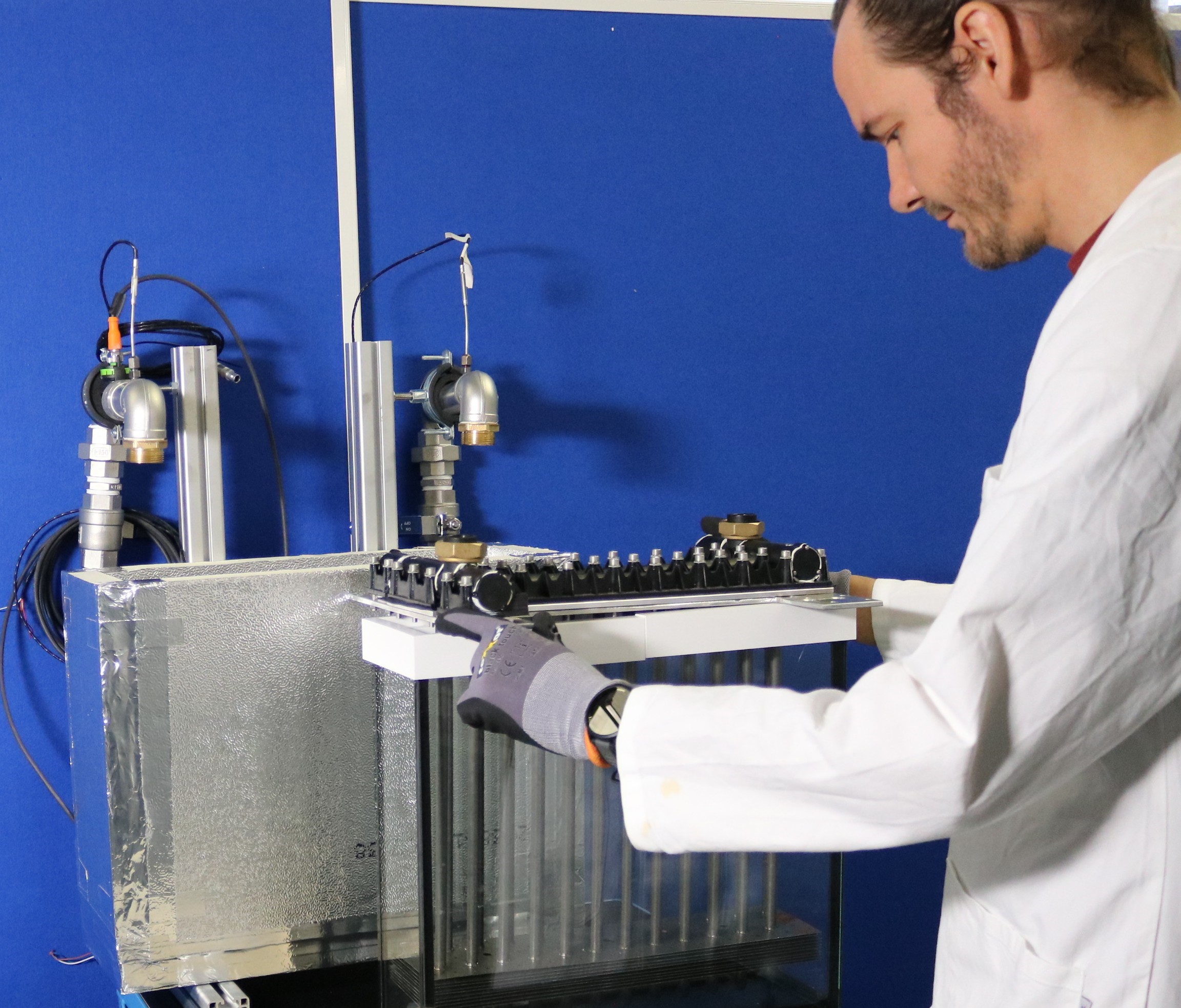
Moritz Walter at Fraunhofer Institute for Chemical Technology ICT in the lab with the recently finished test-rig for laboratory-scale PCM and heat storage system performance measurements. Photo: Moritz Walter/ Carmen Eißler
New generation heating
The project aims to develop a next-generation heat storage system using phase change materials (PCMs). These materials, often made from different types of salt solutions, can store much more energy in the same space by using the energy released or absorbed when they change from solid to liquid. This is a more advanced process than what happens in conventional heating systems, which simply heat water. The specific heat storage capacity in this new technology is much higher.
Improved materials
The scientists working on this project want to improve the materials used inside the thermal storage systems in homes. They are trying to make these materials better at holding and releasing heat repeatedly without breaking down, and to allow heat to move through the system more efficiently.
“Heat storage helps to harmonise the heating of a building. If the heat storage in a building is improved, it will make heating much more efficient,” Walter explains.
The overall aim is to test a physical prototype of the thermal energy storage system. The demonstration plants and buildings currently being used are located in Finland, Germany, and the Czech Republic.
Prioritising households
Now, the consortium is focusing on installing the heating technology in households, as it is much more expensive to implement in larger industrial buildings. This is largely due to pricing concerns, not necessarily limitations with the technology itself.
“It’s a lot more difficult to compete price-wise when output volumes get higher, but the technology itself could definitely be scaled up to larger systems,” he explains.
Because the heat system has a modular design, it can be built in different sizes ranging from small units for single homes to larger ones for shopping centres.
Beneficial partnership
According to Moritz Walter, it has been very beneficial for the consortium to be part of the Clean Energy Transition Partnership.
“I find that it has helped to foster the exchange of ideas between different projects within this research area,” he says.
Walter points to the importance of stakeholder involvement. Securing funding for New HeatIntegrated has also been vital, and being part of the Clean Energy Transition Partnership has provided stable funding for several years, allowing the researchers time to concentrate on further developing their work.
Looking ahead, more meetings and workshops with the companies supporting the current demonstration prototype are being scheduled in order to gather input and suggestions.
“After that, the next stage for us will be looking at how the product can be included in heat storage devices in real buildings. It will look like a compact box that can be added to existing heating systems,” Moritz Walter concludes.
About the project
The consortium consists of three research institutions and two industrial companies. Together, they contribute strong expertise in phase‑change material engineering, thermal energy storage system development, and application‑oriented testing.